Rung 02 of 6 on the ladder
Endoscopic and Minimally Invasive Spine Surgery
The same operation, reached through a smaller opening, when the anatomy allows it.
What it is
The short version.
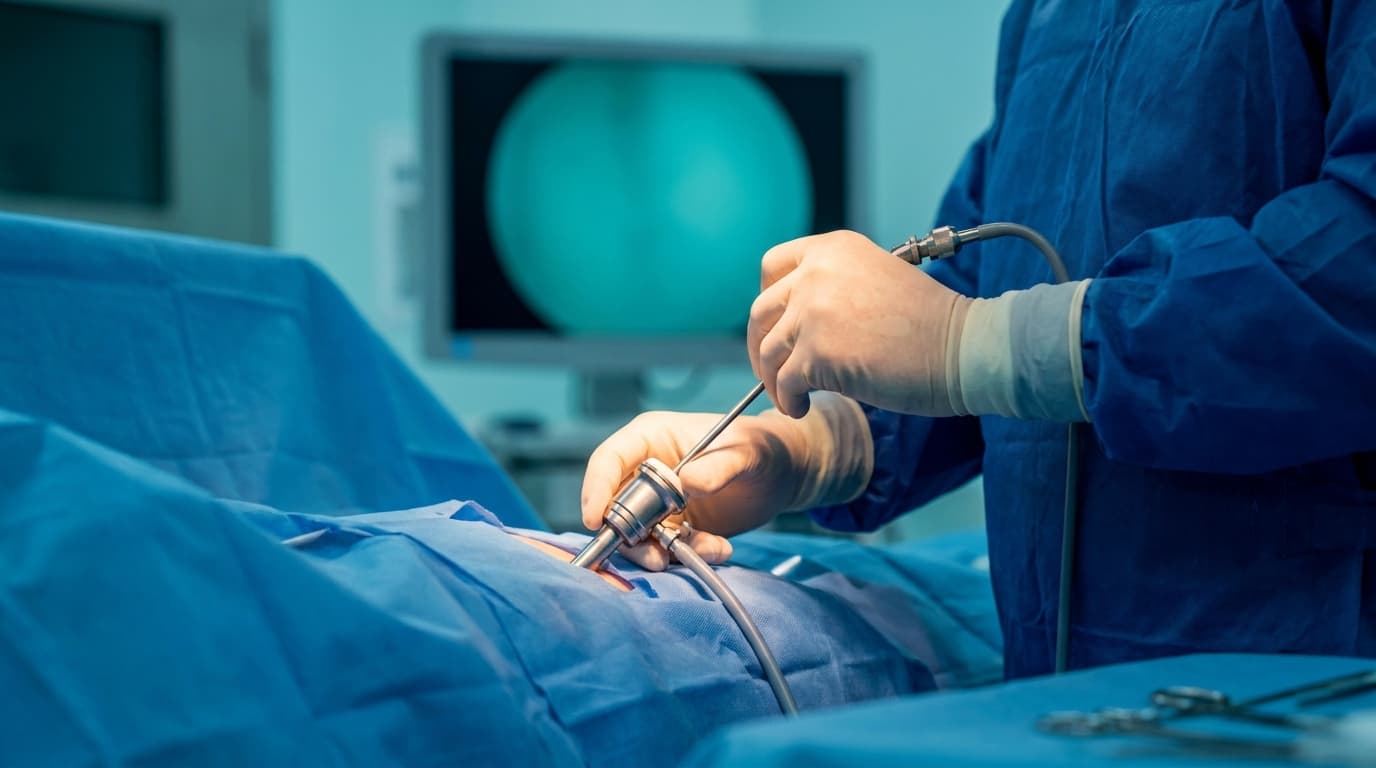
Endoscopic spine surgery uses a small camera passed through a port roughly the width of a pencil, so the nerve can be decompressed while looking directly at it on a monitor. Minimally invasive surgery is the broader family this belongs to: a set of techniques that reach the spine through tubular retractors and muscle-sparing corridors rather than by stripping muscle off bone.
Traditional open spine surgery reaches the problem by detaching the paraspinal muscles from the bone and holding them aside for the length of the case. The decompression itself may be small, but the exposure needed to get there is not, and much of the recovery is spent healing the approach rather than the target.
A tubular or endoscopic corridor dilates those muscles apart instead of cutting them, then works through the gap. The target is treated the same way. What changes is the cost of reaching it.
Is minimally invasive always better?
No, and I think it matters that you hear that from a surgeon rather than from a brochure. A narrow corridor is an advantage only when the problem sits within reach of it. Multilevel disease, significant instability, deformity that needs realignment, and revision cases with scar tissue can all need a wider exposure to be treated properly. Choosing a smaller approach that cannot fully address the problem is not a smaller operation. It is an operation you may have to repeat. The technique should be chosen after the anatomy is understood, not before.
What it offers
Where this approach earns its place.
Less muscle disruption
Dilating muscle rather than detaching it tends to mean less postoperative back pain from the approach itself, which is often what patients notice first.
Smaller incision, less blood loss
A port-based corridor is measured in millimeters. For appropriate single-level problems this generally means less blood loss and a smaller wound to heal.
Often same-day discharge
Many single-level endoscopic and tubular decompressions can be done as outpatient procedures, though whether that is right for you depends on your health, your anatomy, and how the operation goes.
A direct view of the nerve
The endoscope sits at the target rather than outside it, so the decompression is confirmed under magnification at the point where the nerve is actually compressed.
Procedures
What this looks like in practice.
I select the approach that fits the anatomy in front of me rather than defaulting to one technique. These are the minimally invasive procedures I perform most often.
Endoscopic Discectomy
A minimally invasive procedure that uses a small working tube and an endoscopic camera to remove herniated disc material pressing on a spinal nerve root.
Lumbar Microdiscectomy
A minimally invasive operation that removes the portion of a herniated lumbar disc compressing a spinal nerve root, aiming to relieve leg pain and restore function.
Minimally Invasive Decompression
A targeted, muscle-sparing operation that removes the bone and thickened ligament compressing the lumbar spinal canal or nerve root canal through a small incision using tubular retractors.
Posterior Cervical Foraminotomy
A minimally invasive operation performed through the back of the neck to widen the bony canal through which a compressed nerve root exits the spine, relieving arm pain without removing or fusing a disc.
When it is the right choice.
A minimally invasive approach is appropriate when the source of symptoms is clearly identified and can be fully addressed through a narrow corridor, not simply because a smaller incision sounds preferable.
- A single-level disc herniation causing leg or arm pain that matches the imaging
- Focal nerve compression in the lateral recess or foramen
- Spinal stenosis at one or two levels without instability
- Symptoms that correlate cleanly with one identifiable level on MRI
- Pain that has persisted despite an adequate trial of non-surgical care
Am I a candidate?
Most patients ask some version of the same question: am I a candidate for the smaller operation? These are the factors that usually decide it.
- Your symptoms are predominantly radicular (travelling into the arm or leg) rather than diffuse
- Imaging shows compression at a level that explains those specific symptoms
- The segment is stable, without meaningful slip or motion between vertebrae
- You have completed a reasonable course of non-surgical treatment, or you have a neurologic deficit that makes waiting unwise
- Your general health supports an anesthetic
How I approach it
A smaller corridor requires more planning, not less.
Working through a port removes the ability to simply look around, so the operation has to be substantially solved before it starts: which level, which side, what the nerve is likely doing, and what the plan becomes if the anatomy is not what the scan suggested. I would rather spend that time before the incision than improvise through a small one. If during the case the corridor turns out not to be enough to treat the problem completely, the right answer is to open further, and I will have discussed that possibility with you beforehand.
Endoscopic and Minimally Invasive: questions patients ask
How long does recovery take after endoscopic spine surgery?
It varies with the procedure and with you. Many people walking in for a single-level decompression are up the same day and back to light activity within one to two weeks, with restrictions on lifting and bending for longer. Recovery from the approach is usually shorter than after open surgery, but the nerve still heals on its own schedule, and numbness or weakness that took months to develop can take months to improve.
Is endoscopic spine surgery as effective as open surgery?
For the right problem, the decompression achieved is the same, because the target and the goal are the same. The evidence supporting it is strongest for focal, single-level nerve compression. It is not a substitute for an operation that needs a wider exposure, and selecting it for a problem it cannot fully address is the main way these procedures fail.
Will I need a fusion later if I have a minimally invasive decompression now?
Not necessarily. A decompression that preserves the joints and the muscle attachments is designed specifically to avoid destabilizing the segment. Some patients do go on to need stabilization later, usually because the underlying degeneration progresses or because instability was present and became apparent over time. That risk is part of what I assess before recommending a decompression alone.
Do you perform endoscopic spine surgery in Macomb County?
Yes. I practice in Shelby Township and see patients from across Macomb County and Metro Detroit, including Sterling Heights, Utica, Macomb Township, Clinton Township, and Rochester Hills.
Related conditions
Problems this is used to treat.
Not sure whether your problem needs a big operation?
Bring your MRI. Most of what determines the answer is already on it.
Shelby Township, Macomb County. Call (586) 803-1220.