Rung 01 of 6 on the ladder
Non-Surgical Care
Non-surgical treatment is almost always the right first choice, and knowing when it stops being the right choice is the rest of my job.
What it is
The short version.
Non-surgical care is the staged, non-operative treatment of spinal pain and nerve symptoms. It combines physical therapy directed at the specific mechanical problem, changes to how the spine is loaded during the day, medication matched to the type of pain, and image-guided injections used both to reduce inflammation and, in unclear cases, to identify which structure is generating the symptoms.
A spine consultation often runs in one direction. An MRI is obtained, an abnormality is identified, and the conversation moves quickly toward what can be done about that abnormality operatively. Nearly every adult spine MRI contains something that looks wrong, including the scans of people with no pain at all, so a consultation built around the images will almost always find a reason to operate.
The first question I try to answer is a different one: does this finding explain these symptoms, and is this person likely to get better without me? Often the answer is yes. The plan that follows is a specific non-surgical one with a defined timeline and a defined point at which I look at it again, rather than an open-ended instruction to live with it.
When does waiting become the wrong choice?
Patience is a treatment, but it is not a default, and there are situations where time genuinely costs you something. Progressive weakness is the clearest one: pain that comes and goes can be watched, a foot or a grip that is getting weaker week by week generally cannot. Signs of spinal cord compression belong in the same category, and they are easy to miss because they do not always hurt: dropping objects, trouble with buttons or handwriting, a change in balance or the way you walk. Any change in bowel or bladder control, new numbness in the saddle area between the legs, or the sudden inability to urinate can indicate cauda equina syndrome, which is a surgical emergency and a reason to go to an emergency department the same day rather than wait for an appointment with me. Fever, unexplained weight loss, night pain that wakes you, or a history of cancer also change the calculation, because they raise the possibility of infection or tumor rather than degeneration. Outside of those, waiting is usually not dangerous. Inside of them, it is the one thing I would ask you not to do.
What it offers
Where this approach earns its place.
Most episodes settle without an operation
Many disc herniations shrink over time and many episodes of back or neck pain improve within weeks to a few months. Surgery cannot be undone, so the natural history is worth respecting before it is overruled.
Therapy aimed at your actual problem
Generic core exercise and a directed program for a specific mechanical pattern are not the same treatment, and patients who say therapy failed them have often had the first when they needed the second.
Injections that can answer a question
An image-guided injection can reduce inflammation around an irritated nerve, and it can also be diagnostic. If numbing one specific nerve root temporarily removes your leg pain, that tells me something an MRI cannot.
Nothing is spent that cannot be spent later
Non-surgical care keeps every option open. If it does not work, the operation is still available, and you will have arrived at it knowing that the smaller measures were genuinely tried.
What this involves
What this looks like in practice.
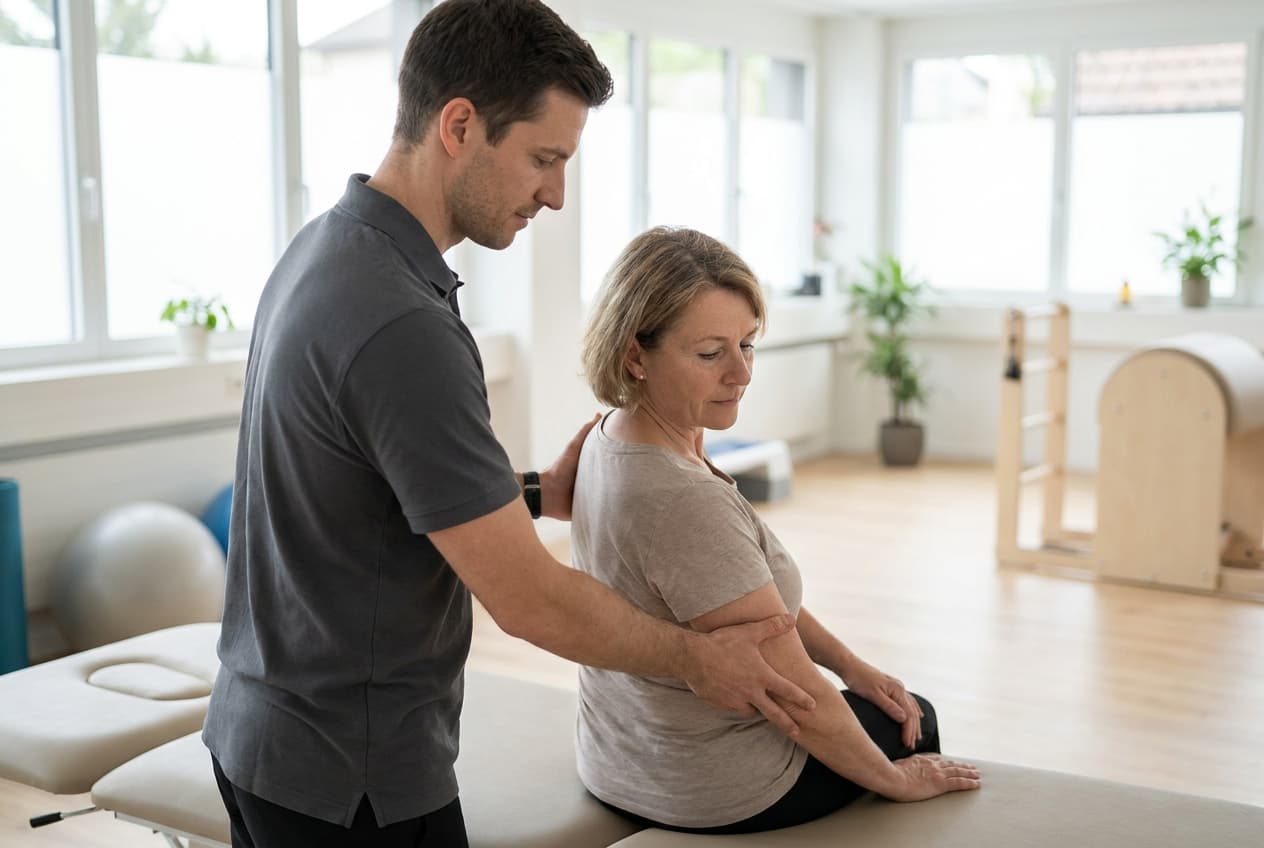
Non-surgical care is not one treatment, it is four working together: a directed physical therapy program, deliberate changes to how you load your spine through the day, medication matched to whether the pain is mechanical or neuropathic, and image-guided injections when a specific target needs treating or confirming.
When it is the right choice.
Non-surgical care is the appropriate starting point for the large majority of spinal complaints, not simply a formality to be completed before surgery is authorized.
- Axial neck or back pain without neurologic deficit
- Radicular pain of recent onset with normal strength on examination
- Lumbar disc herniation causing pain but no motor loss
- Stenosis with neurogenic claudication that limits walking distance but is not rapidly progressing
- Imaging findings that do not clearly account for the symptoms being described
- Symptoms that may be arising from the hip, the shoulder, the sacroiliac joint or a peripheral nerve rather than from the spine
Am I a candidate?
Most patients ask the reverse of the question they arrived with: is it safe for me to wait? These are the factors that usually decide it.
- Your strength is normal and stable when examined, not merely when described
- Your symptoms are painful but not worsening week over week
- You have no change in bowel or bladder control and no numbness in the saddle area
- You have no signs of spinal cord compression, such as hand clumsiness, dropping objects or an unsteady gait
- You have not yet had a genuine trial of directed therapy, which usually means several weeks of the right exercises rather than a few visits of the wrong ones
How I approach it
Recommending against surgery requires more confidence than recommending it.
It is easier to operate than to explain convincingly why an operation is not the answer. Telling someone in real pain that the plan is time, therapy and a reassessment asks them to trust a diagnosis instead of a procedure, and that only works if the diagnosis is right. So that is where the effort goes: examining you rather than only your scan, deciding whether the abnormality on the MRI is the one producing your symptoms, and taking seriously the conditions that send people to spine surgeons unnecessarily, including hip arthritis, shoulder pathology, peripheral neuropathy and vascular claudication. If the honest answer is that you do not need me, I would rather say so plainly, give you a specific plan, and tell you what would have to change for us to revisit it.
Non-Surgical Care: questions patients ask
Should I see a spine surgeon if I do not want surgery?
Yes, and it is a common reason people come in. A large part of a spine consultation is deciding whether an operation is needed at all, which means reading the imaging against the examination and ruling out the conditions that imitate spine problems. Seeing a surgeon is not a commitment to having surgery, and a consultation that ends with a non-surgical plan is a normal outcome rather than a wasted visit.
How long should I try physical therapy before considering surgery?
For radicular pain with normal strength, a reasonable trial is often somewhere between six weeks and three months of directed therapy, though this varies with the diagnosis and with how you are progressing. What matters more than the calendar is the direction of travel: symptoms that are slowly improving usually justify continuing, and symptoms that are worsening or accompanied by weakness justify looking again sooner. Red flag symptoms such as progressive weakness, changes in bowel or bladder control, or saddle numbness should not be given a waiting period at all.
Can a herniated disc heal without surgery?
Often, yes. Herniated disc material frequently shrinks over time as the body resorbs it, and the inflammation around the nerve tends to settle even when the disc itself does not fully disappear. Many people improve substantially without an operation. The exceptions are herniations causing significant or progressive weakness, and cauda equina syndrome, where waiting is not appropriate.
What does an image-guided injection actually tell you?
Two things, and they are separate. Therapeutically, steroid placed near an inflamed nerve root or a facet joint may reduce pain, sometimes for months, though the response varies considerably between patients. Diagnostically, the anesthetic in the injection is informative in its own right: if numbing one specific nerve root briefly removes your leg pain, that supports that level as the source, and if it changes nothing, that is useful too. In an ambiguous case I sometimes order an injection primarily for the answer rather than the relief.
Do you offer non-surgical treatment in Shelby Township?
Yes. My office is in Shelby Township and I see patients from across Macomb County and Metro Detroit, including Sterling Heights, Utica, Macomb Township, Clinton Township and Rochester Hills. Non-surgical care is coordinated from that visit: therapy referrals, medication, and image-guided injections when a specific target has been identified, with a scheduled point at which I reassess rather than an indefinite wait.
Been told you need surgery and want to know whether that is true?
Bring your MRI and the recommendation you were given. A second opinion that ends in 'not yet' is still a useful answer.
Shelby Township, Macomb County. Call (586) 803-1220.